In industry, air pollution control is not just an option, but a necessity to protect the environment, comply with strict regulations, and maintain employee health. Spiral scrubbers occupy a unique position among the many purification technologies as a smart, efficient, and cost-effective technical solution. These systems combine the mechanical strength of a spiral gas separator with the high efficiency of a wet scrubber to remove a wide range of pollutants.
What is a cyclone gas cleaner and how does it work?
A cyclone air purifier is an air purification system that uses centrifugal force to separate particles and liquid droplets from the airstream. This system essentially combines two physical principles:
-
The principle of the cyclone: separation of large particles and droplets.
-
Cleaning principle: absorption and separation of gaseous pollutants and small particles.
The operating phases of a cyclone gas cleaner are as follows:
-
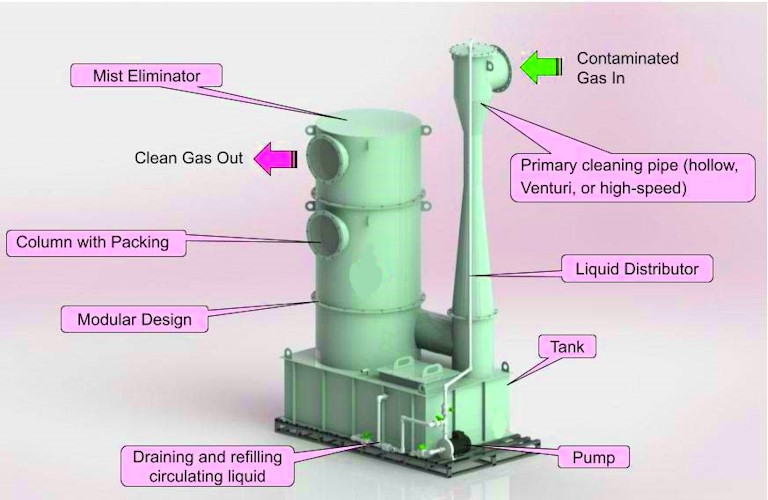
Dual inlet (gas and liquid): The contaminated gas stream enters the device’s cylindrical chamber at high velocity and tangentially, along with compressed air or steam. At the same time, a cleaning fluid ( usually water, sometimes with the addition of special chemicals) is injected into the gas stream.
-
Cyclonic action and entrainment: When gas enters the chamber tangentially, a strong rotating motion, a vortex, is created. This vortex pushes dirt particles and liquid droplets against the outer walls of the device. Solid and liquid particles collide, and small particles are captured by larger droplets (entrainment).
-
Centrifugal separation: Strong centrifugal forces push heavy particles, liquid droplets, and moist contaminants against the cyclone walls. These particles and droplets are then transported through the walls into a collection container.
-
Clean gas outlet: The lighter, cleaner airflow is now directed to the center of the unit (the vortex core), where the pressure is lower, and exits through the outlet pipe (vortex flow restrictor) at the top of the unit. Sometimes a drip catcher or draft eliminator is installed at the outlet to capture any small droplets remaining in the airflow.
-
Sludge discharge: A mixture of water and collected contaminated materials (called sludge or sludge) collects at the bottom of the facility and is then drained for appropriate treatment or disposal.
The main advantages of cyclone washing systems
-
Highly efficient removal of large particles and some gases: These systems offer excellent removal of medium and large particles (greater than 5–10 micrometers) as well as aerosol droplets. By adding chemicals to the cleaning fluid, gaseous pollutants such as sulfur dioxide and hydrogen chloride can also be absorbed.
-
Low maintenance costs: The simple design and the absence of complex moving parts in the airflow path (such as internal fans) ensure low energy consumption and significantly reduce maintenance costs.
-
High heat and corrosion resistance: These washing machines are designed for use in high-temperature and corrosive environments. The service life of the machines can be significantly extended by choosing the right materials, such as stainless steel, fiberglass, or rubber lining.
-
The space requirement is relatively small: it generally requires less space than other cleaning systems, such as sand cleaners.
-
High humidity regulation capability: The device easily handles moisture-laden air currents.
Polymer preparation station REM srl-stpl-es-0910
Disadvantages and limitations
-
Limited efficiency with very fine particles: When separating very fine particles (less than 2-3 micrometers), the efficiency of these systems drops to below 90% because the centrifugal forces have less effect on these light particles.
-
Pressure drop: The energy required to generate vortices and particle collisions causes a pressure drop in the system, which increases operating costs due to the need for larger fans.
-
Wastewater management: The wastewater (sludge) generated in this system requires proper treatment and disposal, which can be a complex and expensive process.
-
Risk of frost: In cold weather, the liquid inside can freeze if the system is not properly insulated.
Industrial applications of cyclone scrubbers
Cyclone scrubbers are used in a wide range of industries due to their versatility and performance , including:
-
Metallurgy: Dust and acid mist control in furnaces, foundries, and descaling plants.
-
Chemical and pharmaceutical industries: Capture of dust and chemical vapors in reactors, dryers, and material handling systems.
-
Power generation and waste incineration: Control of ash and gaseous pollutants in boiler flue gas cleaning systems and waste incineration plants.
-
Food industry: recovery of valuable powders (e.g. milk powder and whey) and odor removal in spray dryers.
-
Wood and furniture industry: Control of wood dust in extraction systems of CNC machines, saws and sanders.
Conclusion: How to choose a cyclone washing machine
For many industrial applications, a cyclone scrubber is a wise investment. System selection should be based on several factors, including particle type and size, gas flow rate, temperature, humidity, and contaminant concentration . While more complex systems (such as filters or venturi scrubbers) may be required to clean very fine particles , cyclone scrubbers offer a balance between efficiency, capital costs, and operating costs in many common applications .
This powerful technology uses simple physical laws and plays a crucial role in cleaning industrial flue gases, enabling more sustainable and responsible production.