Harmful gases, particulate matter, and chemical vapors are generated in all industries and pose a serious threat to the environment and human health. One of the most important technologies for controlling these pollutants is the Venturi air filter . This wet filter device effectively removes suspended particles and some gaseous pollutants thanks to high gas flow rates and direct contact with the cleaning fluid.
In this article, we will give a complete overview of the Venturi pressure washer, its working principle, area of application, advantages, limitations and the main points of its operation.
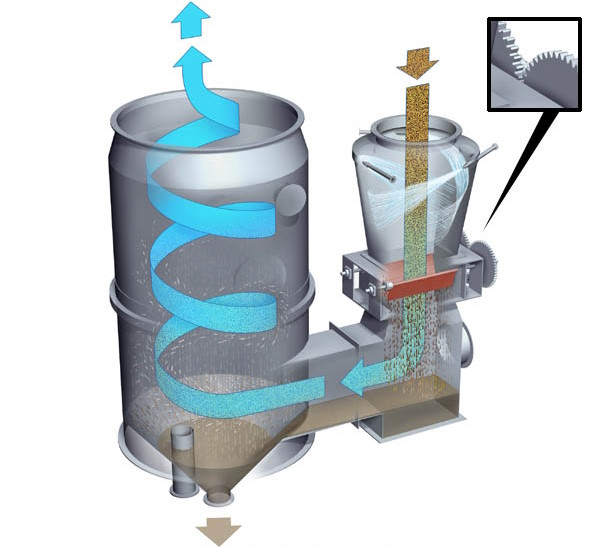
What is a Venturi washer?
A Venturi air purifier is a device for capturing particulate matter and pollutants from industrial gases. Its name derives from the Venturi tube —a tube with a narrow cross-section in the center that increases flow velocity and reduces pressure.
In this device, contaminated gas flows at high velocity through a Venturi tube into which a cleaning fluid (usually water or a chemical solution) is injected. The strong contact between the cleaning fluid and the particles traps and collects them.
How does a Venturi washing machine work?
The device’s operating process is typically divided into three phases:
-
Dirty gas inlet: Gas with suspended particles enters the inlet section.
-
Venturi throat: In this section, the gas velocity increases significantly and cleaning fluid is injected into the gas stream.
-
Due to the increase in speed, the liquid breaks up into very small droplets.
-
Intense collisions between liquid droplets and gas molecules lead to particle capture.
-
-
Separation section: After passing the throttle valve, the liquid enters the separator (cyclone separator or droplet separator), which separates the contaminated liquid with the captured particles from the clean gas.
Main features of the Venturi washing machine
-
Highly efficient detection of small particles (less than 1 µm)
-
Creates a significant pressure drop , increasing collection efficiency.
-
Use water or a chemical solution as the absorption liquid.
-
Possibility of removing both particles and gas vapors (when using reactive solutions)
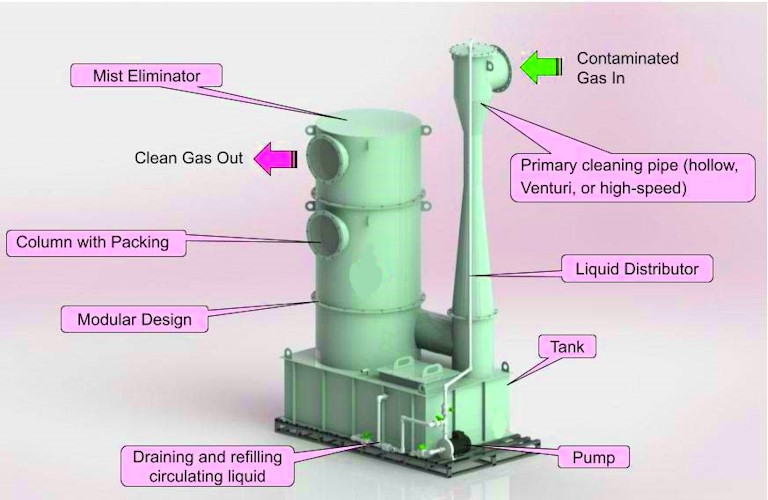
Using a Venturi washer
Venturi air purifiers are used in various industrial plants due to their efficiency:
-
Power plants: removal of fly ash and particles from fuel combustion
-
Chemical industry: detection of acid vapors and hazardous particles
-
Cement and ceramics plants: Control of exhaust dust
-
Metallurgy: Removal of particles produced during the melting and casting of metals.
-
Food and pharmaceutical industries: process dust and vapor control
-
Waste incineration plants: Control of toxic particles and hazardous pollutants
Advantages of the Venturi washing machine
-
Very high efficiency in removing fine particles.
-
Even particles as small as 0.5 micrometers can be effectively detected.
-
-
Can remove particles and gases.
-
By selecting the appropriate solution, acidic gases such as HCl, SO₂ and NH₃ as well as particles can be absorbed.
-
-
Flexibility in application
-
It can be used in different industries and for different types of pollutants .
-
-
simple mechanical structure
-
The design with no moving parts reduces the likelihood of mechanical failure.
-
Disadvantages and limitations
-
High energy consumption: Due to the high pressure drop, powerful fans are required.
-
Wastewater: Water contaminated with particles and pollutants must be treated or disposed of.
-
Corrosion of equipment: When using corrosive chemical solutions, the machine body must be provided with an anti-corrosive coating.
-
High operating costs: They require higher maintenance and energy costs than some dry filters.
Design and main components
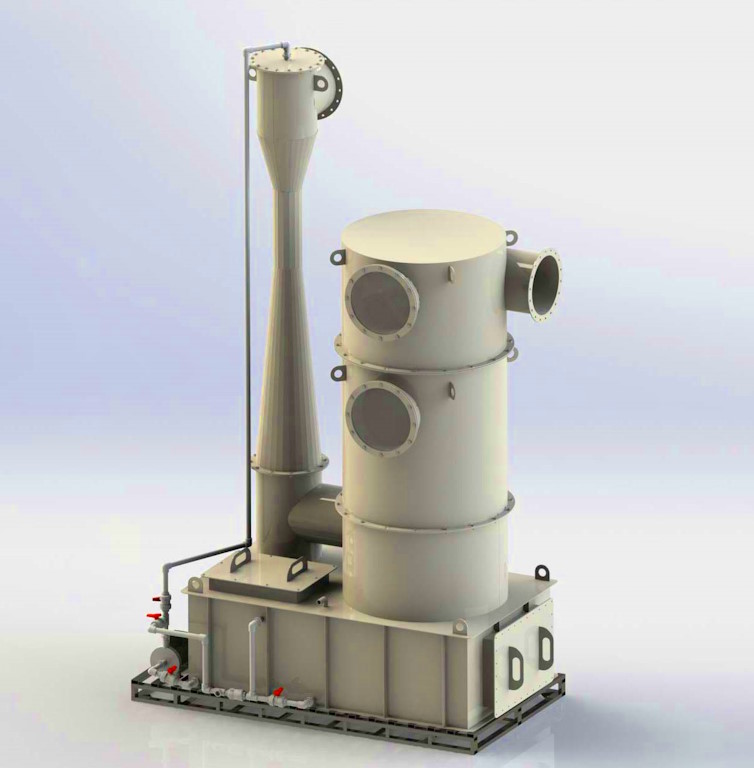
A Venturi washer typically consists of the following components:
-
Reception report
-
Venturi larynx
-
Liquid injection systems (nozzles or injectors)
-
The diffuser section reduces the flow velocity.
-
Liquid and gas separators ( cyclone separators or mist separators)
-
System for collecting and cleaning contaminated liquids
Maintenance and operation
To achieve optimal performance from your Venturi washer, follow these steps:
-
Monitor the quality of the cleaning fluid to avoid deposits or excessive contamination.
-
Check the nozzle regularly to ensure an even spray.
-
Repair or replacement of parts worn due to chemical exposure.
-
Industrial wastewater management with industrial water treatment systems
Comparison of Venturi air purifiers and other air purifiers
-
Compared to an electrostatic atomizer (ESA): The Venturi atomizer is better suited for wet and sticky particles, but consumes more energy.
-
Compared to dry scrubbers, Venturi tubes are more effective at removing fine particles, but require a wastewater treatment system.
-
Compared to simpler scrubbers, Venturi scrubbers achieve better performance with very fine particles.
The future of Venturi air purifiers
In the face of stricter environmental regulations, new technologies are improving the efficiency of venturi scrubbers and reducing energy consumption. These innovations include:
-
Use advanced nozzles to spray liquids more efficiently.
-
Improved design to reduce pressure drop
-
Intelligent flow and pressure control system
-
Wastewater collection and recycling to reduce water consumption
Finally
Venturi air purifiers are among the most effective air purification devices in numerous industries. Due to the uniform contact between gas and liquid, these devices effectively remove particulate matter and chemical vapors. While energy consumption and wastewater production are significant concerns, proper design and maintenance ensure efficient operation and a long service life.