From massive power plants to chemical plants, many large industries constantly face the challenge of producing the products society needs without emitting toxic gases and pollutants that harm human health and the environment. In many cases, the solution to this critical problem lies in a system called a wet scrubber.
Wet scrubbers, also known as wet scrubbers , are among the most common and effective air purification technologies worldwide. These engineered systems use the energy of fluids (usually water) to filter and remove pollutants from exhaust gases. Read on to learn more about how these systems work, their types, and their importance to modern industry.
How does a wet vacuum cleaner work? Cleaning principle
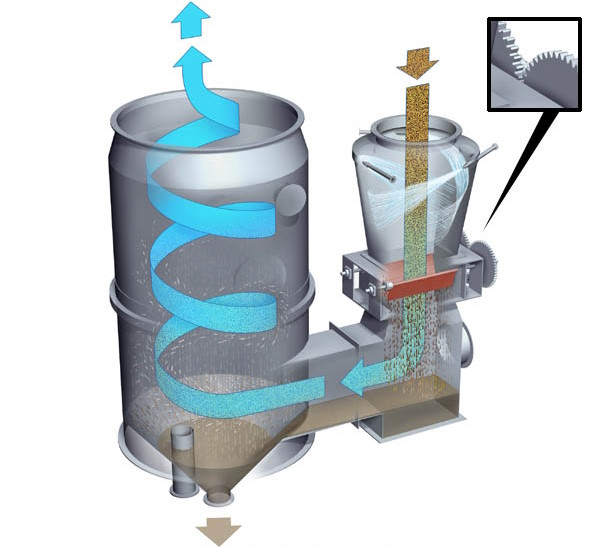
All wet scrubbers operate according to a simple and innovative principle: They improve the contact between the contaminated gas stream and the smallest droplets of the cleaning fluid. This microscopic contact leads to the separation of the contaminants from the gas phase (air) and their transition to the liquid phase. This process is achieved through the following physical and chemical mechanisms:
-
Effect: Due to inertia, pollutant particles cannot quickly deviate from the trajectory of the droplets , collide directly with them and are absorbed.
-
Interceptors: Particles large enough to approach and contact a droplet.
-
Diffusion: Very small particles ( smaller than one micrometer) hit the drop surface due to their uniform Brownian motion and are absorbed.
-
Chemical absorption: When a chemical solution (such as caustic soda) is used to neutralize acidic gases, a chemical reaction occurs that converts the pollutants into harmless compounds.
After contact, the clean gas is released into the atmosphere and the liquid with the collected contaminants (filtrate) is collected for proper cleaning and disposal.
Main types of wet cleaning machines: different tools for different tasks
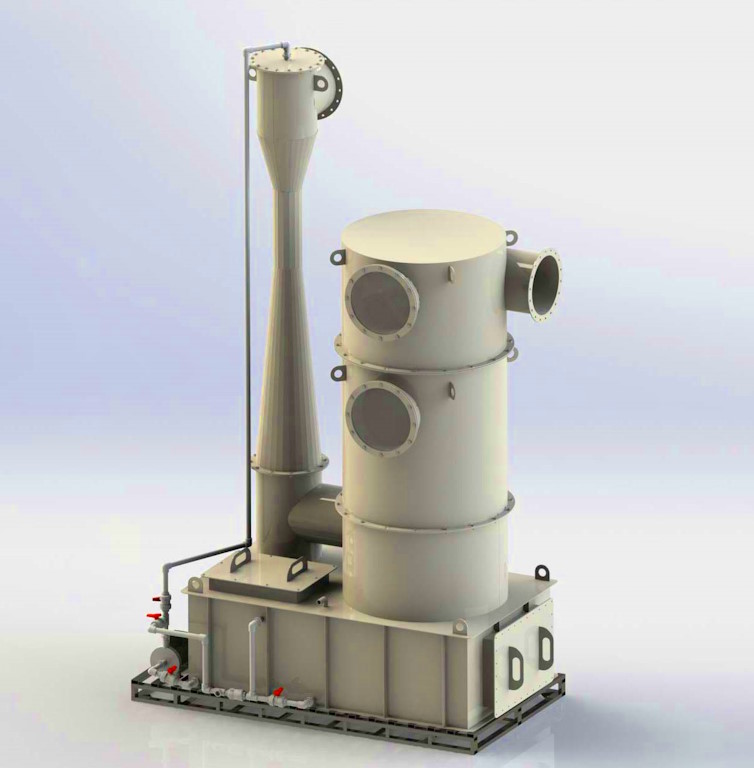
Not all wet air purifiers are the same. Choosing the right type depends on several factors, including the type of pollutant (particles or gases), particle size, temperature, and pollutant concentration. Here are some of the most common types:
1. Venturi air filter: A fine particle filter. Venturi air filters are
among the most effective systems for removing fine and very fine particles (even smaller than a micrometer) from air streams. Their design is based on increasing velocity and decreasing pressure .
-
Operating principle: Contaminated gas flows at high velocity through a narrow channel (Venturi tube). At the same time, water or cleaning fluid is injected into the gas at high velocity. The large velocity difference between gas and liquid breaks the droplets into very small particles , increasing the contact area. The strong impact of the contaminated particles on the droplets causes them to be sucked in and ejected.
-
Areas of application: Metallurgical industry , waste incineration plants, cement works and all places where very fine particles are produced.
2. Compact gas scrubbers: These units, specially designed for gas removal,
are ideal for removing gaseous pollutants (such as sulfur dioxide, hydrogen chloride, hydrofluoric acid, and chlorine) and steam and are characterized by high efficiency.
-
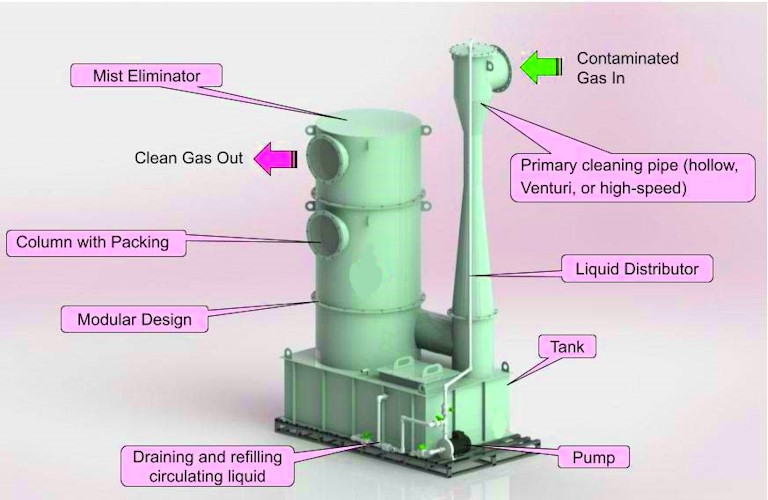
Operating principle: The interior of the vertical column is filled with packings or gaskets made of plastic, ceramic, or metal. These packings significantly increase the contact area between gas and liquid. A cleaning fluid is sprayed onto the packing from above, forming a thin layer. The contaminated gas enters the column from below and rises through the space between the packings. Gas and liquid are in close and continuous contact, resulting in the absorption or neutralization of gaseous contaminants.
-
Areas of application: power plants, chemical and petrochemical industries, food industry, sewage treatment plants (for odor removal).
3. Spray tower: simple and economical.
The spray tower is the simplest wet washing device that requires no fillers.
-
The principle: Gas enters the tower from below and rises upwards. At this point, the upper nozzles spray the cleaning fluid downwards in small droplets. Contaminants are absorbed upon contact with this “blue curtain.”
-
Application: Suitable for removing large particles and cooling hot gases. Efficiency is lower than that of Venturi and bag filters, but acquisition and maintenance costs are lower.
4. Cyclone gas purifier: Combines centrifugal force and drip irrigation technology.
This device combines the design of a cyclone gas separator (which uses centrifugal force to separate particles) and a water spray system.
-
Operating principle: Contaminated gas enters the cylindrical chamber transversely and moves in a spiral motion, performing an intense rotational movement. At the same time, water is sprayed into the rotating air stream. Centrifugal force propels contaminant particles and water droplets against the chamber walls, where they eventually settle at the bottom of the container .
-
Application: Removes medium and large particles.
The main advantages of wet cleaning
-
They are very efficient: they can remove particles and gases simultaneously , sometimes achieving an efficiency of over 99%.
-
Flexibility: By varying the type of cleaning solution (e.g. adding alkali to neutralize acid), many different stains can be controlled.
-
Cooling and drying: Cooling hot exhaust gases and, if necessary, dehumidification.
-
Safety: Makes the work environment safer by eliminating explosive and corrosive gases.
-
Odor control: They are very effective in controlling unpleasant industrial odors.
Disadvantages and problems
-
Liquid waste: The biggest problem with these systems is the creation of “wastewater,” or contaminated wastewater, which requires a separate and expensive wastewater treatment system.
-
Energy consumption: Due to the “pressure drop” in the gas stream, powerful and energy-intensive fans are required, which increases energy costs.
-
Corrosion: The often humid and acidic environment inside a washing machine is extremely corrosive and requires the use of corrosion-resistant materials such as stainless steel, fiberglass or special seals .
-
Freezing: In cold areas, external system components may freeze and special precautions may be required.
Conclusion: A fundamental investment in a responsible industry.
Despite the challenges facing wet scrubbers, they remain a cornerstone of the industry’s environmental responsibility. Not only must they comply with pollution control regulations, but they also reflect the industry’s concern for the health of its employees, local communities, and the planet.
With the continuous development of corrosion-resistant materials, energy-efficient designs, and wastewater collection and treatment systems, the future of wet scrubbers is evolving toward more efficient and environmentally friendly solutions. This technology has proven to be a reliable link between industrial production and environmental sustainability.