In today’s industrial world, factories, power plants and manufacturing sectors are the main engines of the economy. However, this powerful engine often has serious consequences: air pollution , posing a serious threat to human health and the environment. This is where gas cleaning technology comes in, becoming the ideal solution for the balance between industry and the environment.
This article talks about the washing machine, its principle of operation, types and main applications. Its importance in modern industry is also emphasized.
What is a gas cleaner?
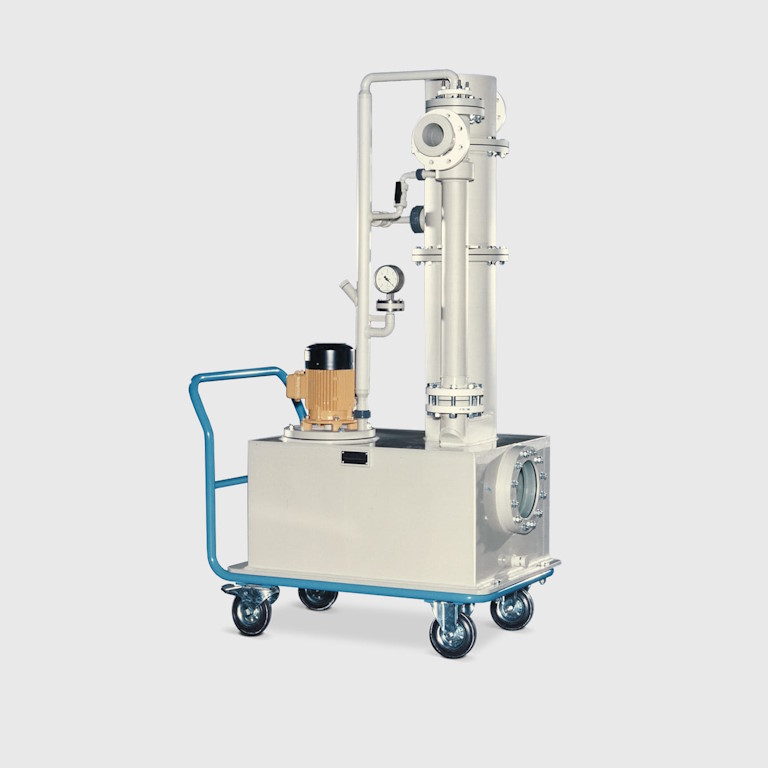
A scrubber is an air purification system used to remove certain pollutants from flue gases. These pollutants include particulate matter, toxic and odorous gases, and vapors. In this contact, the pollutants are separated from the gaseous phase and transformed into the liquid phase, as a result of which the purified gas is released into the atmosphere.
How do gas scrubbers work?
The cleaning process in a washing machine is based on the principle of mass transfer. Its main stages are as follows:
-
Gas-liquid contact: Contaminated gas flow enters the scrubber. At the same time, a scrubber (cleaning) liquid is injected through nozzles at the top of the tower, creating a wide contact surface between the liquid droplets and the gas molecules.
-
Absorption and transport of contaminants: Pollutants present in the gas (e.g., sulphur dioxide, hydrogen chloride and fine particulate matter) are absorbed or dissolved by droplets. This transport may be a simple physical process (dissolution) or a chemical reaction.
-
Separation: A liquid containing absorbed contaminants (called “filtrate” or effluent) is collected at the base of the tower. The purified, lighter gas is removed from the top of the tower.
-
Leachate Treatment: Collected leachate cannot simply be disposed of as it is contaminated industrial wastewater. Therefore, it is usually sent to a separate water treatment system to remove or neutralize contaminants, allowing water to be reused or safely disposed of.
Main types of gas scrubbers
Purifiers can be divided into different categories depending on how they work and the type of contaminants they remove:
1. Wet washers
They are the most common type and use a liquid (usually water) for cleaning. They are divided into several subcategories:
-
Venturi scrubbers are highly efficient for removing fine particles. In this type of scrubber, the gas passes through a narrow channel (venturi tube) at high velocity, and the cleaning fluid is injected into the gas stream at high velocity.
-
Nozzle scrubbers are ideal for removing gaseous contaminants. The column is filled with a layer of plastic or ceramic to increase the surface area.
-
Spray column scrubber: The simplest type of wet scrubber. The liquid is sprayed through the upper nozzles and the gas rises from the bottom up. It is less efficient than other types, but is suitable for cleaning large particles.
-
Cyclone washers: By creating vortex motion in the gas, they provide better contact between the gas and the liquid and use centrifugal force to separate the heavy droplets.
2. Dry Scrubbers:
These systems use a dry adsorbent (e.g., hydrated lime or sodium bicarbonate) instead of a liquid. The contaminated gas passes through a layer or cloud of this powder, where the contaminants chemically react with the adsorbent to form a dry, harmless solid. This technology is particularly widely used in power plants to control sulfur dioxide emissions.
3. Although an electrostatic precipitator (ESP) is not a well-known scrubber, it is a type of particle cleaning system. In this system, flue gas particles are charged by a strong electric field and attracted to oppositely charged collector plates.

Main applications of gas scrubbers
Cleaning devices play an undeniable role in many industries:
-
Power plants: Removes sulfur dioxide (SO₂) and nitrogen oxides (NOx) from coal-fired power plant exhaust.
-
Metallurgy: Inspection of acid gases (such as HF and HCl) and metal particles in foundries and steel mills.
-
Chemical and petrochemical industry: Removal of acid vapours, volatile organic compounds (VOCs) and other hazardous chemicals from manufacturing processes.
-
Food industry: elimination of unpleasant odors that occur during the processing of food products.
-
Waste incineration (incinerator): Control the generation of highly toxic and corrosive gases such as hydrochloric acid, sulfur dioxide and dioxins during the waste incineration process.
-
Pulp and paper industry: Management of odorous and corrosive gases and vapors.
Advantages and disadvantages of gas scrubbers
peculiarity:
-
High Efficiency: It is capable of removing particles and gases at the same time with exceptional efficiency.
-
Flexibility: A wide range of contaminants can be controlled by selecting the appropriate liquid or sorbent.
-
Cooling: Hot exhaust gas cooling.
-
Safety: Improve workplace safety by eliminating explosive and corrosive gases.
Disadvantages and problems:
-
Energy costs: Powerful, energy-intensive fans are required to overcome the pressure drop that occurs in the system.
-
Liquid waste: Forms leachate or sludge that requires complex and costly treatment and disposal systems.
-
Corrosion: The humid, acidic environment inside the washing machine is extremely corrosive, so corrosion-resistant materials such as stainless steel or special coatings must be used.
-
Frost: In cold weather, frost can be a problem for outdoor components.
Conclusion: Investing in a Clean Future
A gas cleaner is more than just a device; it is a symbol of corporate environmental and social responsibility. Despite the challenges associated with energy consumption and waste disposal, its benefits for protecting public health, complying with strict environmental regulations and promoting sustainable development make it a critical investment.
As technology advances, a new generation of scrubbers is emerging, providing greater energy efficiency and water conservation, as well as the ability to recover valuable materials (such as sulphur) from leachate. Scrubbers are expected to continue to drive the development of a sustainable industry and become a reliable barrier to pollution.